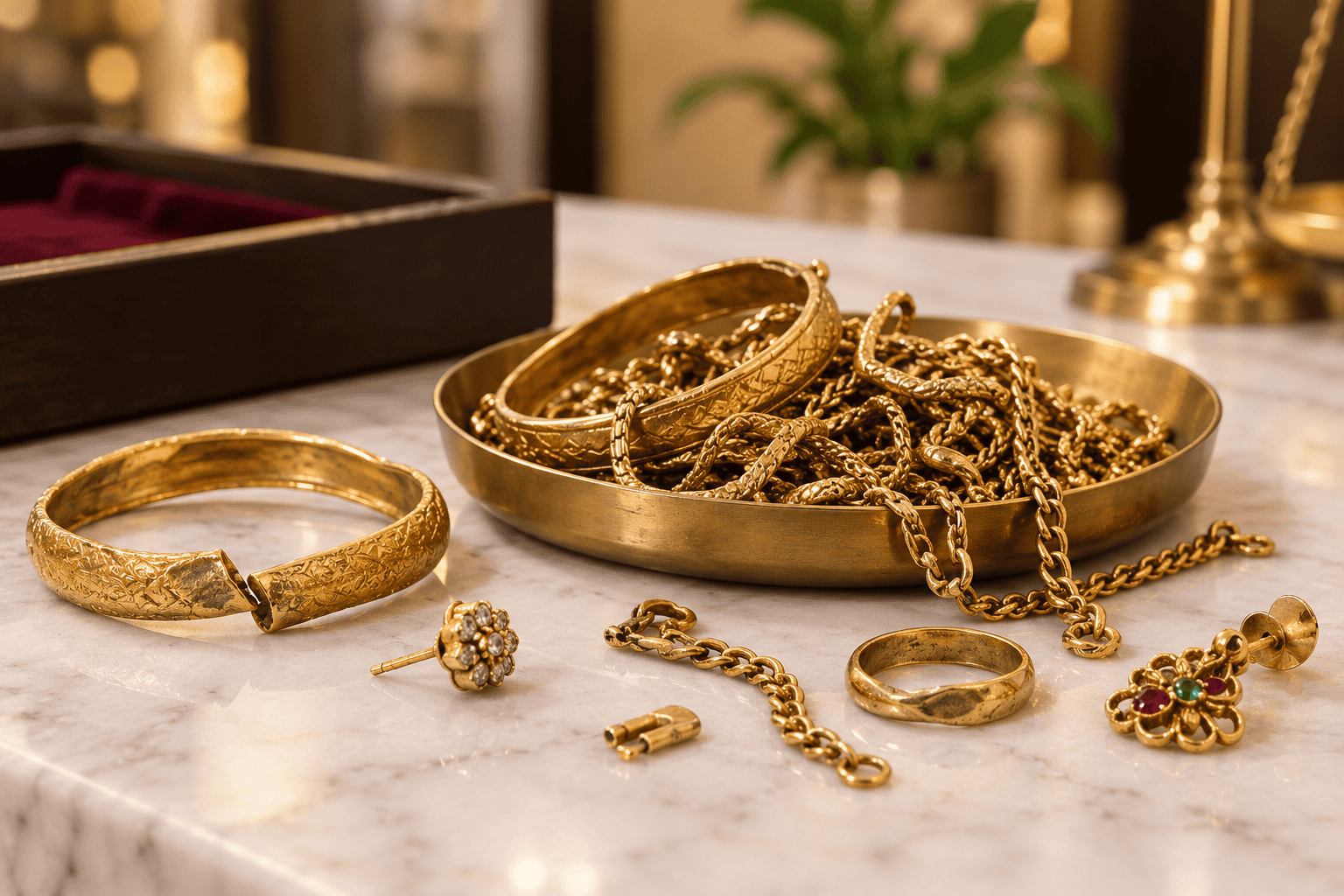
A bent bangle, a tangled chain, a single earring whose partner vanished years ago, a clasp that snapped — most households have a drawer of gold that is no longer wearable. The common assumption is that damaged gold is worth less. It is not. Here is why condition has almost nothing to do with what your gold will fetch.
The Key Insight: Your Gold Will Be Melted
When you sell old gold to be refined, it does not matter whether it is pristine or mangled — it is going to be melted down either way. The buyer is not paying for the piece as jewellery to be resold and worn; they are paying for the gold content. A dented bangle and a perfect one of the same weight and purity are worth exactly the same.
💡 Condition affects a piece's value as jewellery to wear, not its value as gold. Since old gold is sold to be melted, dents, breaks and missing pairs make no difference to the payout.
What Actually Determines the Value
Only two things:
- Weight — how much gold is there, measured on a calibrated scale.
- Purity — how pure it is, confirmed by testing.
Neither changes because a piece is bent, scratched, or incomplete. The formula stays the same: weight × purity factor × current rate.
Common "Damaged" Cases — and Why They're Fine
- Single earrings: a lone earring is valued on its gold like anything else. No pair needed — you are selling metal, not a matched set.
- Bent or crushed pieces: shape is irrelevant to a refiner. Full value applies.
- Broken chains and snapped clasps: the break changes nothing about the gold content.
- Tangled or knotted chains: weight is weight, however tangled.
- Tarnished or discoloured gold: real gold does not rust. Surface discolouration does not lower purity, and testing confirms the true figure.
- Worn, thinned pieces: valued on their current weight — you simply have slightly less gold than when new, and are paid accordingly.
The Myth to Ignore
Some buyers treat damage as an excuse to quote less — implying broken or unpaired gold is harder to handle or worth less. It is not. Once the gold is tested and weighed, its condition is irrelevant to a refiner. A "damage deduction" on scrap gold is a pricing tactic, not a real cost.
💡 There is no such thing as a legitimate "damage" or "broken piece" deduction on gold sold for melting. Only genuine non-gold weight — stones, thread, a non-gold clasp — is fairly set aside.
The One Real Exception
Condition matters in only one situation: if a piece has value beyond its gold — a genuine antique, a signed designer item, or a collectible whose craftsmanship is worth more than its metal. In that rare case, selling it as scrap for melting would waste that extra value, and you should have it appraised by a specialist first. For ordinary damaged jewellery, though, melt value is the right and full value.
What to Do With Your Drawer of Odd Pieces
- Gather everything — odd earrings, broken chains, bent rings — and sell it together.
- Don't bother repairing pieces you intend to sell; repair adds cost for no gain, since it's melted anyway.
- Have any non-gold parts (stones, non-gold clasps) noted so only genuine gold weight is counted.
- Watch the weighing and testing, and confirm no "damage" deduction is applied.
The Bottom Line
Damaged, bent, tarnished and unpaired gold is worth its full metal value — weight and purity are all that count, and neither is changed by condition. Don't let anyone persuade you that a broken chain or a single earring is worth less than the gold it contains. The only time to pause is if a piece might be a genuine antique worth more than its metal.
Ready to sell?
Full Value for Broken & Odd Gold
No damage deductions · XRF tested · Instant cash · T Nagar
Ready to Sell Your Gold?
Free evaluation, instant cash, no obligation. T Nagar, Chennai.
📞 Call +91-7603862150Was this helpful? Visit Pragadee Gold in T Nagar or call +91-7603862150 for a free gold evaluation today.